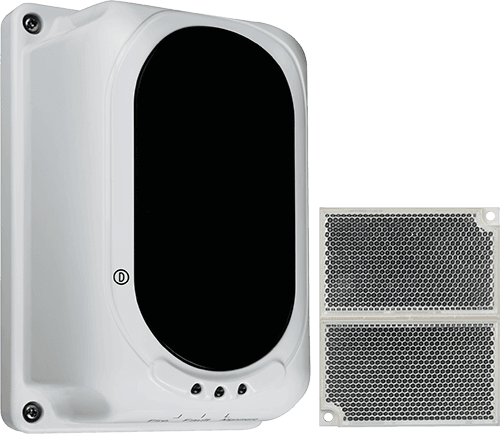
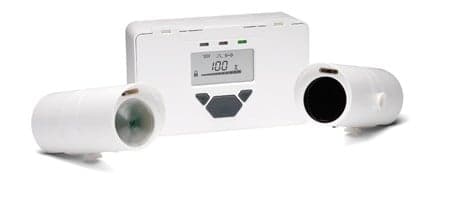
OSID Imager Beam Smoke Detector
Open-area Smoke Imaging Detection (OSID) Receiver Unit with 80 ° coverage. A technological innovation in the field of linear optical detection. Range detection:6-34m.
Request a quoteDescription
OSID Smoke Detectors are used for early warning smoke detection, OSID provides a lowcost, reliable and easy-to-install solution that overcomes typical beam detection issues such as false alarm incidents and alignment difficulties. The OSID system measures the level of smoke entering beams of light projected over an area of protection. A single OSID Imager can detect up to seven Emitters to provide a wide coverage area. Two innovations in smoke detection technology have been developed for the revolutionary OSID smoke detector: Dual Wavelength Particle Detection The beam projected from each Emitter contains a unique sequence of ultraviolet (UV) and infrared (IR) pulses that are synchronised with the Imager and enable the rejection of any unwanted light sources. By using two wavelengths of light to detect particles, the system is able to distinguish between particle sizes. The shorter UV wavelength interacts strongly with both small and large particles while the longer IR wavelength is affected only by larger particles. Dual wavelength path loss measurements therefore enable the detector to provide repeatable smoke obscuration measurements, while rejecting the presence of transient dust particles or solid intruding objects. Optical Imaging with a CMOS Imaging Chip An optical imaging array in the OSID Imager provides the detector with a wide viewing angle to locate and track multiple Emitters. Consequently, the system can tolerate a much less precise installation and can compensate for the drift caused by natural shifts in building structures. Optical filtering, high-speed image acquisition and intelligent software algorithms also enable the OSID system to provide new levels of stability and sensitivity with greater immunity to high level lighting variability. Operation Status information (Fire Alarm, Trouble and Power) is communicated through the Imager via Status LEDs, dedicated Trouble and Alarm relays, and the Remote Indicator interface. Specific Trouble (Fault) conditions are identified through coded flashes of the Trouble LED. An internal heating option is also provided on the Imager to prevent condensation on the optical surface, and a reset input enables an external signal to reset the device
Features & Benefits:- Maximum detection range of 200 m (656 ft) for the OSI-10
- Dual wavelength LED-based smoke detection
- Optical imaging with CMOS imaging chip
- On-board event log for fault and alarm diagnostics
- High tolerance to false alarm due to building movement
- High tolerance to transient dust, steam and intrusion of solid objects
- Easy alignment with large adjustment and viewing angles
- No need for precise alignment
- Tolerant of alignment drift
- Automatic commisioning in under ten minutes
- Simple DIP switch configuration
- UL
- ULC
- FM
- CSFM
- NF-SSI (AFNOR) *
- CE – CPR & EMC
- VdS
- BOSEC
- CCCF
- ActivFire
- VNIIPO
Technical Specifications
| Brand | NOTIFIER; Xtralis |
|---|
Documents & Technical Downloads
Declaration of Performance
Declaration Of Performance · en
OSID-DE and OSID-R Battle Card
Battlecard · en
Xtralis VESDA Open Protocol HLI
Data Sheet · en
OSID Smoke Detection Data Sheet
Data Sheet · en
OSID Smoke Detection Data Sheet
Data Sheet · en
OSID Smoke Detection Data Sheet
Data Sheet · en
OSID Data Sheet
Data Sheet · en
Xtralis Osid Line Smoke Detectors-Declaration of Performance
Declaration Of Performance · en
Aspirating Smoke Detection Sell Sheet
Sell Sheet · en
How to Sell New Technologies in Advanced Detection for Double Digit Growth Slide Presentation
Slide Presentation · en
Open-area Smoke Imaging Detection -OSID- Brochure
Brochure · en
Notifier Overview Slide Presentation
Slide Presentation · en
TRADE PRODUCT LIST Catalog
Catalog · en
OSID Imagers and Emitters Datasheet
Data Sheet · en
OSID General Datasheet
Data Sheet · en
OSID Smoke Detection Data Sheet
Data Sheet · en