
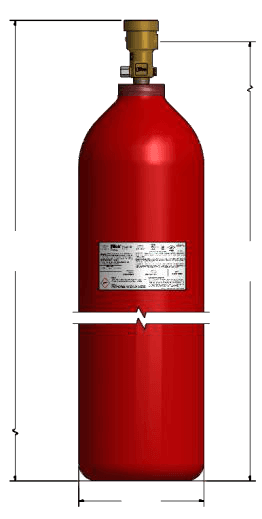
Fike CO2 Cylinder Assembly
Factory-filled high-pressure CO2 cylinder assemblies in 50, 75 and 100 lb capacities, with siphon tubes for full liquid discharge and UL, FM, ULC and USCG approval.
Request a quoteDescription
Factory-filled high-pressure CO2 cylinder assemblies in 50, 75 and 100 lb capacities, with siphon tubes for full liquid discharge and UL, FM, ULC and USCG approval.
The Fire Suppression Science Behind CO2
Because the sustainability of a fire requires fuel, heat and oxygen, removing one of these elements from the equation will extinguish the fire. Fike’s CO2 Fire Suppression System reduces oxygen to extinguish most fires, including:
Retaining the agent within the protected space reduces the fire’s ability to re-ignite. In addition, CO2 has a cooling effect on the surrounding atmosphere that benefits fire extinguishment. Because carbon dioxide is a gas, no cleanup is required after a Fike CO2 fire suppression system discharges.
It is approximately 50 percent heavier than air, and is normally present in the atmosphere at about 0.03 percent by volume. When applied to a fire, CO2 provides a heavy blanket of gas that reduces the oxygen level to a point where combustion cannot occur.
- Surface or “flash” type fires: oils, paints, etc.
- Deep-seated or “smoldering” type fires: paper, baled cotton, clothing, etc.
- Localized applications: ship engines, dip tanks, oil-coated surfaces.
When Is The Use Of CO2 Effective?
CO2 is effective in areas where flammable solids and liquids are present. Fires in these hazards spread very rapidly. Deep-seated fires associated with hazards such as electrical equipment, bulk record storage, dust collectors, and ductwork are equally well protected with CO2. A fixed-pipe system that is engineered specifically for a particular hazard, and actuated automatically, assures the early detection and rapid extinguishment necessary to prevent major losses and downtime.
Fike CO2 Systems are custom designed to protect a specific hazard or application. The quantity of CO2 and the method of application required for the protection of a specific hazard are determined by the system designer, but the final design must be based on the materials or product involved. NFPA 12 and this design manual are used as guides to determine the appropriate design parameters. Fike CO2 systems can be actuated automatically, pneumatically or manually. Automatic systems incorporate fire detectors and system control panels, along with electric and mechanical/manual releases that are located in the hazard area. When activated, they send a signal to the control panel to release the CO2 into the hazard. Mechanical/manual actuator(s) are generally located at, or near, the CO2 cylinder storage area. Automatically actuated systems are electrically operated and always incorporate an emergency manual override feature and standby power supply.
Catalogue reference identifies this product or system family. Individual configurations and ordering part numbers vary; consult the official documentation.
Technical Specifications
| Approvals | UL Listed; FM Approved; ULC Listed; USCG Approved; DOT 3AA2015 (50 lb) and DOT 3AA2300 (75 and 100 lb) |
|---|---|
| Average shipping weight | 160 lb (73 kg) for 50 lb; 220 lb (100 kg) for 75 lb; 330 lb (150 kg) for 100 lb |
| Brand | Fike |
| Cylinder assemblies | C70-100 100 lb (45 kg), C70-075 75 lb (34 kg) and C70-050 50 lb (23 kg) |
| Material | Steel |
| Mounting | Upright floor-mounted only; horizontal mounting is not allowed |
| Paint | Red gloss baked enamel over oil-based primer |
| Siphon tube | Fitted to allow full discharge of the liquid CO2 agent |
| Thread size | 1-11 1/2 NGT, female |
